Table of contents
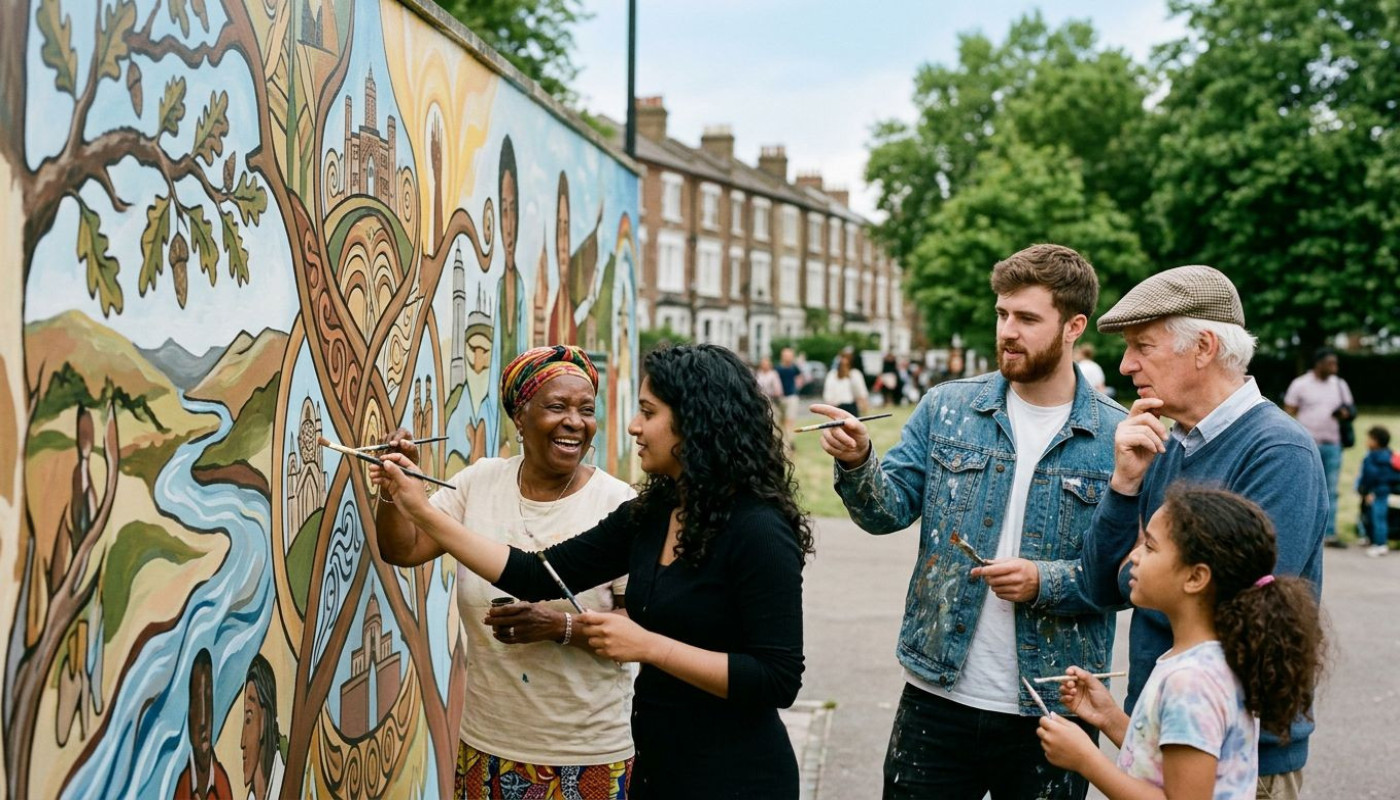
Can art redraw the borders of belonging? Across Europe, Africa and the Americas, cultural institutions are increasingly asked to do more than exhibit, they are expected to heal divides, bring newcomers into the story of the nation and, in polarized times, offer spaces where disagreement stays civil. From community murals to museum overhauls, artistic projects are being funded as soft infrastructure for social cohesion, yet the evidence is mixed, and the politics of who gets represented, and who gets paid, remain contentious.
When art becomes a civic meeting place
It starts, often, with a room and a microphone, and the simple invitation to speak. Cultural “third places” have become a recurring policy bet in many countries, built on the idea that a theatre workshop, a local library’s residency programme or a museum night can do what formal politics struggles to do, namely, bring strangers into sustained contact without forcing immediate consensus. The logic is backed by a long research tradition in social psychology: sustained, cooperative contact under fair conditions can reduce prejudice, and shared tasks can loosen rigid in-group and out-group boundaries. In practice, the most effective artistic projects tend to resemble well-run civic forums, with clear rules, skilled facilitation and an explicit commitment to inclusion, rather than one-off spectacles.
Some of the most cited examples come from Northern Ireland, where decades of “community arts” were folded into peacebuilding, not because murals or theatre scripts magically ended conflict, but because they created repeat encounters, new networks and, crucially, non-violent ways to compete over memory. That is a key point for any discussion of national belonging: art works less like a sedative and more like a language. It gives people symbols to argue with, stories to test and spaces to inhabit together, and those elements matter because belonging is not only a legal status but also a daily experience of recognition, access and voice.
Large comparative surveys help explain why this can work. The OECD’s work on trust and social connections, and the European Social Survey’s long-running data on social capital, regularly show that participation in associations correlates with higher interpersonal trust, and arts participation is one of the more accessible “association-like” activities, especially where it is subsidised. Correlation is not causation, but it offers a clue: when institutions make cultural participation cheaper, local and welcoming, they can widen the circle of “people like me” beyond family and close friends. The civic effect is not automatic, though, and it depends on who shows up, and on whether the space feels safe to those who have historically been kept at the edges.
The numbers: who participates, who feels included
Belonging has to be measured, otherwise it stays in the realm of slogans. Here, the data are both encouraging and sobering. In the European Union’s cultural participation surveys and in UNESCO’s cultural policy reporting, a persistent pattern appears: education and income predict cultural attendance, even in countries with strong public funding. Museums, theatre and classical music remain more frequented by higher-income groups, while community festivals and popular music events attract broader demographics, and digital cultural consumption has widened reach but not necessarily deepened shared experience. If an artistic project is meant to foster a national “we”, yet it primarily draws the already-connected, the risk is that it becomes a polished echo chamber that inadvertently reinforces class divides.
That is why many public funders now ask projects to document outreach, demographic breadth and local partnerships, and why evaluation has become more rigorous. In the United Kingdom, for instance, publicly funded culture has long been subjected to participation metrics, and while the system is debated, it has pushed institutions to prove that they are not only serving metropolitan elites. Meanwhile, in Canada and Australia, where national identity is inseparable from Indigenous sovereignty and migration, cultural programmes are often assessed through lenses of representation and self-determination, not just visitor counts. The metrics are evolving, and that evolution is a political story in itself: what gets measured reveals what the nation thinks matters.
Yet even the best dashboards cannot easily capture the most meaningful outcomes, such as whether a newcomer feels entitled to speak in a public debate, or whether a young citizen of immigrant background sees their family history as part of the national narrative rather than a tolerated footnote. Qualitative studies, including ethnographies of participatory arts projects, often find micro-shifts: increased confidence, new cross-group friendships, greater willingness to engage with local institutions. Those changes are real, and they accumulate, but they are fragile, and they can be wiped out by hostile media cycles, economic shocks or political rhetoric that reactivates exclusion.
One practical implication follows: artistic projects are strongest when they are not asked to do everything alone. They can complement, but not replace, housing policy, anti-discrimination enforcement, language access, and fair pathways to legal status. In debates about citizenship and migration, administrative realities matter too, including the clarity of procedures, processing times and the costs people face when they try to regularise their lives. Even apparently technical questions, such as Sao Tome citizenship government fees, can shape how individuals imagine belonging, because fees, paperwork and bureaucratic predictability determine whether “the nation” feels like a door that opens or a wall that speaks in forms and stamps.
Memory, symbols and the battle over “the nation”
Nothing tests the promise of art like a fight over history. The past is never neutral, and artistic projects that aim to broaden belonging quickly run into questions about whose suffering is recognised, whose heroes are celebrated and whose monuments stay on pedestals. Over the last decade, controversies around statues and museum collections have shown how cultural institutions can become arenas for national self-argument, particularly in former imperial powers and in societies shaped by slavery, colonisation or civil conflict. When museums re-label objects, return artefacts or commission new works that speak back to older narratives, they are not only curating; they are renegotiating the moral boundaries of the nation.
In France, the United Kingdom, Belgium and beyond, heated debates have forced cultural leaders to confront a dilemma: if they avoid politics, they can appear complicit in exclusionary myths; if they engage, they can be accused of rewriting history or importing “culture wars.” The more productive projects tend to do two things at once, and that duality is hard. They acknowledge historical harm without turning the conversation into a zero-sum contest for victimhood, and they invite audiences into complexity rather than pushing a single moral script. National belonging, after all, cannot be sustained by denial, but it also cannot survive endless moral purges that leave citizens feeling that nothing in their shared story is redeemable.
Examples of this balancing act can be seen in participatory memorial projects, where communities contribute objects, testimonies and artwork, and in theatre or documentary projects that stage multiple perspectives side by side. When done well, such work does not demand agreement; it demands attention. It teaches a civic skill that democracies urgently need: listening to a story that challenges your own, and staying in the room. That skill, multiplied across schools, local councils and cultural venues, becomes a form of national glue, not because it erases difference but because it makes difference governable.
But there is also a risk of aestheticising trauma, and critics have a point when they warn against “performative inclusion,” where institutions display diversity without shifting power. If decision-making, commissioning budgets and leadership remain homogeneous, then inclusive programming can feel like a veneer, and communities notice. Belonging is intensely sensitive to hypocrisy; people may tolerate exclusion, but they rarely forgive being used as a symbol. That is why governance changes, such as community advisory boards with real authority, transparent commissioning processes and long-term partnerships, matter as much as the artworks themselves.
What works, what fails, and what it costs
Money is where ideals meet reality. Artistic projects that foster belonging tend to be labour-intensive: they require facilitators, translators, community organisers, childcare, accessible venues and time, and time is expensive. Short funding cycles, often one year or less, push organisations into a treadmill of grant-writing and quick outputs, which favours visible events over slow relationship-building. If the goal is a new sense of national belonging, a one-off festival is rarely enough; it may generate a feel-good headline, but durable trust usually emerges from repeated interactions over months and years.
Evaluations of participatory arts often underline this point. Projects that show stronger social outcomes are typically those embedded in local institutions, such as schools, youth clubs, libraries and municipal cultural centres, where participants return week after week and where staff can respond to conflict, dropout and fatigue. By contrast, projects designed primarily for branding, tourism or prestige can struggle to deliver inclusion, because they optimise for audiences, not participants. This does not mean large national programmes are useless, but it does suggest that national belonging is built from the local level up, through institutions that remain present after the cameras leave.
There are also predictable failure modes. If a project is framed as “integrating” minorities into a fixed national culture, it can feel patronising, and people disengage. If it treats identity as a marketing category, it can provoke backlash and harden boundaries. If it ignores economic insecurity, it can be dismissed as elitist, especially in regions where public services are under strain. The most resilient projects avoid moralising tones, and they connect cultural participation to tangible benefits, such as skills, networks, paid opportunities and civic access. Paying participants, commissioning local artists fairly and ensuring that community partners are compensated are not just ethical choices; they are signals that the nation values people’s time and expertise.
For policymakers, the cost question is unavoidable, and it is often misunderstood. Cultural budgets are small compared with health, education or infrastructure, yet they can be leveraged for high social visibility. The challenge is to avoid instrumentalising art as a cheap substitute for social policy, while still recognising that culture can be a smart investment in cohesion. A pragmatic approach focuses on multi-year funding, transparent criteria, rigorous evaluation and partnerships that link culture to schools, adult education and local democracy. That is how artistic projects can move from symbolic gestures to sustained civic architecture.
Practical pointers before you commit
For readers looking to support or join such projects, start locally, and ask how long the initiative is funded, who makes decisions, and whether participation is genuinely open. Budget matters: look for free or subsidised entry, and check whether travel costs or childcare are covered. Many cities offer cultural passes, community grants and school-linked programmes, and charities can help with access.
On the same subject

How Arts And Culture Influence Modern Self-help Books

Enhancing Home Decor And Storage With Artisan Wicker Baskets

Exploring The Impact Of Stylish Shower Curtains On Bathroom Aesthetics

Legal Implications of Online Sports Betting in Bangladesh

What could the arrival of José Mourinho bring to PSG ?

4 best French cartoons to watch on Netflix

How to play and win at Lucky Jet?

What are the advantages of marketing automation?

Ceramic or porcelain plates : how to choose ?

A QUICK OVERVIEW OF THE GROWING AIR CONDITIONER MARKET IN CHINA AND HOW TO FOSTER IN THE AIR CONDITIONER BUSINESS IN CHINA

All about the Tongue Drums

Why play the porn game ?

Opening a business : what to do ?

Why should you choose an online financial data management agency?

Some Tips for Choosing a Battery for Your Computer

Visitax, No More Secrets for You

Where to find the best dinosaur store?

Some key legal considerations for starting a tarot reading business and online

Why prefer a timelapse camera?

All about Tikee the ideal site camera

Digital: what do you need to know about the portfolio ?

How to create a chatbot?

How to find the missing dog?

How do I use the permatex plastic sealer ?
